
Research Context
This report represents the second phase of the investigation into foreign-linked influence activity associated with actors aligned with the Islamic Republic of Iran. While the first phase established the structural foundations of the network through quantitative analysis of 7,924 account records, this phase builds upon those findings by refining actor typologies, examining narrative objectives across crisis contexts, and analyzing how influence mechanisms operate within Western information environments. The analysis should therefore be understood as a continuation and expansion of the initial dataset rather than a separate investigation.
1. Conceptual Introduction: Narrative Manipulation as an Instrument of Power
Narrative manipulation refers to the systematic shaping of how events, actors, and outcomes are perceived rather than altering the events themselves. In contemporary information environments, power is increasingly exercised through control of interpretation, legitimacy, and emotional framing rather than direct censorship alone.
In authoritarian influence operations, narrative manipulation serves three primary strategic functions:
- Reducing the visibility of genuine dissent,
- Reshaping external risk perception, and
- Fragmenting collective understanding to prevent coordinated response.
Unlike disinformation, which relies on falsity, narrative manipulation often operates using selective truth, emphasis, omission, and framing, making it more resilient to fact-checking and more difficult to attribute.
2. Scope and Objective
This research summarizes methods and actor configurations employed by the Islamic Republic of Iran to influence, distort, and control public perception in Western information environments over the past three years.
The analysis is grounded in large-scale OSINT analysis of X (formerly Twitter) and builds on Golden Owl’s prior identification of coordinated, state-aligned influence infrastructure consisting of more than 7,500 unique accounts.
The focus of this section is how narrative control is operationalized, rather than reiterating network scale already established in previous findings.
3. Methodology
3.1 Research Design
This study employed a multi-phase open-source intelligence (OSINT) methodology combining quantitative network analysis with structured qualitative content review.
The research evolved in two analytical layers:
- Large-scale quantitative classification based on behavioral and structural indicators
- Expanded qualitative typology refinement through crisis-period content analysis
The objective was to identify role-based actor architecture, activation timing, and narrative manipulation methods, rather than assess isolated posts.
3.2 Phase 1: Quantitative Network Classification
The initial dataset consisted of:
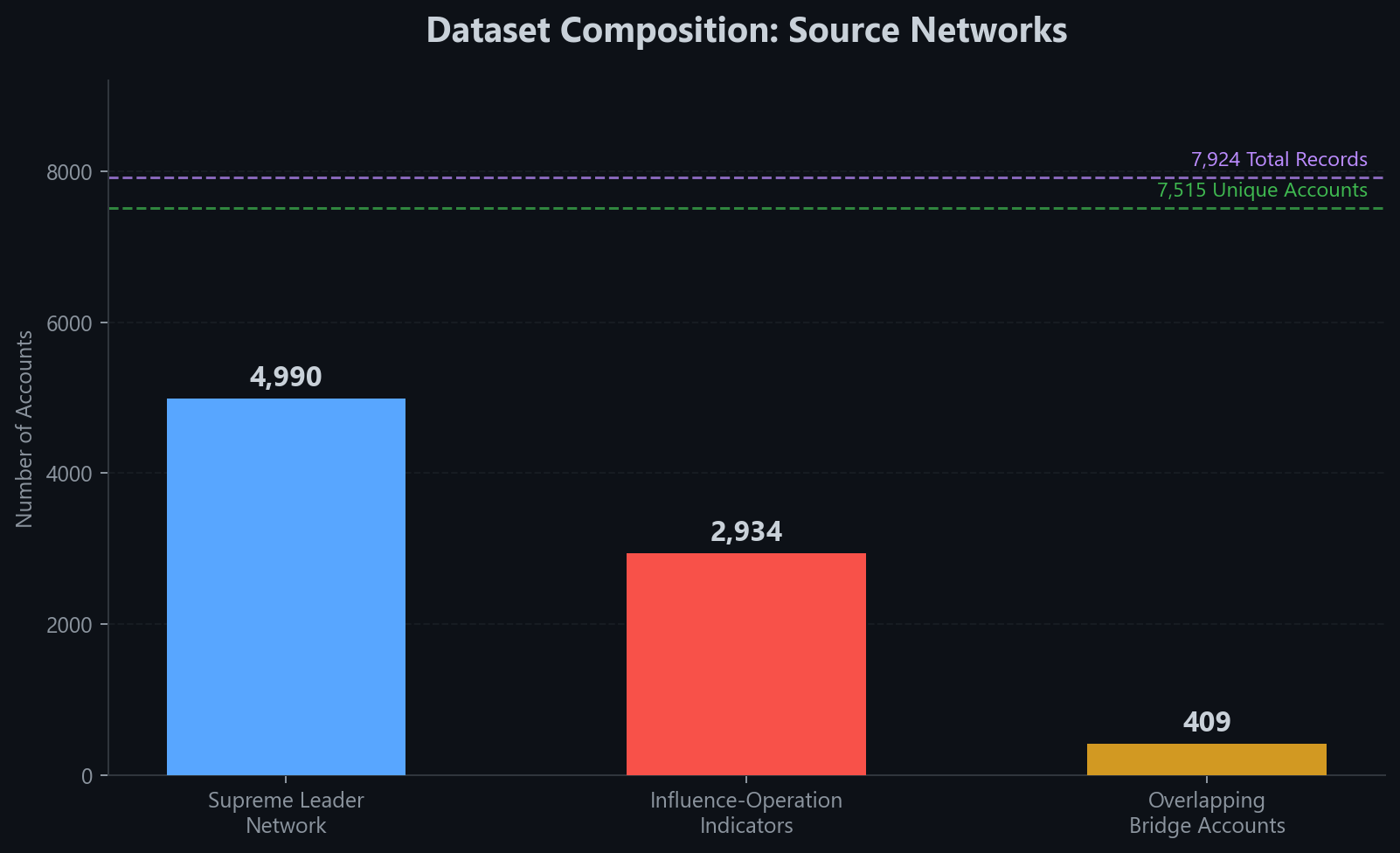
- 7,924 total account records
- 7,515 unique accounts (after removal of 409 overlapping records)
Accounts were drawn from two interconnected datasets:
- 4,990 accounts engaging with the Islamic Republic’s Supreme Leader network
- 2,934 accounts exhibiting influence-operation indicators
Quantitative Role Distribution
| Category | Count | % of Total | Role in Network |
|---|---|---|---|
| Originators | 510 | 6.4% | High-influence narrative drivers |
| Amplifiers | 2,503 | 31.6% | High-volume content spreaders |
| Bot-Type Accounts | 1,857 | 23.4% | Automation or centralized-operation indicators |
| High-Suspicion Accounts | 1,497 | 18.9% | Multiple inauthentic behavior signals |
| Organic Ideological Supporters | 1,557 | 19.7% | Accounts expressing regime-aligned views |
| Total | 7,924 | 100% | — |
Additional quantitative indicators included:
- 2,139 accounts (27%) created after October 7, 2023
- 409 overlapping bridge accounts (5.44% of unique accounts)
- 490 accounts posting 100+ times per day
- 2,478 accounts with minimal or empty biographies
- 797 accounts with numeric username patterns (6+ digits)
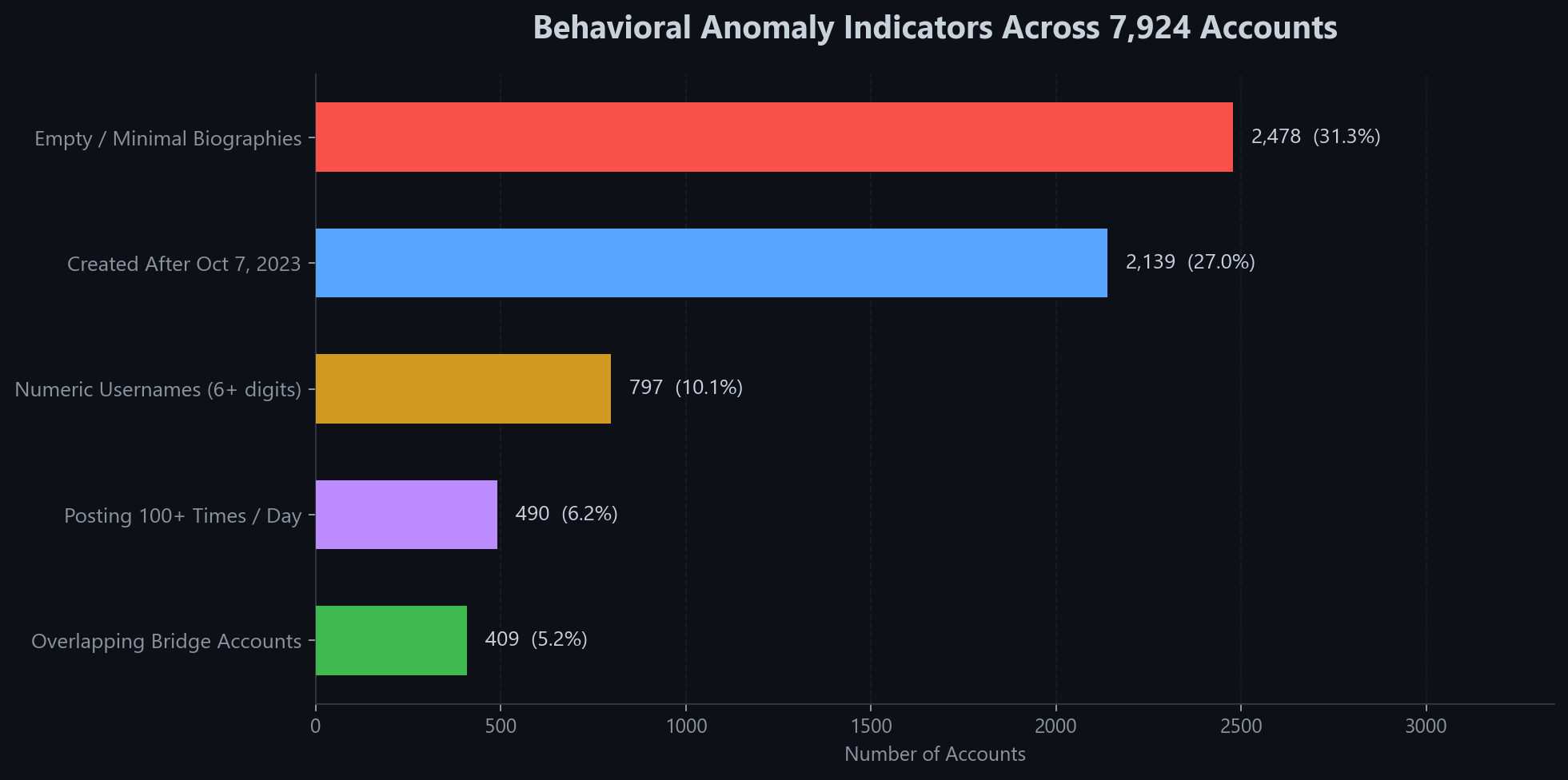
These metrics formed the empirical basis for structural role identification.
3.3 Phase 2: Expanded Actor Typology Through Qualitative Analysis
While Phase 1 established the macro-structure of the network through quantitative classification, it did not fully capture nuanced actor roles such as embedded influencers, opposition-positioned agents, or intelligence-gathering accounts.
To refine and expand the classification framework, researchers conducted structured qualitative analysis of:
- Accounts previously identified in Phase 1 across originator, amplifier, and high-suspicion categories
- An additional 200 high-impact accounts, including influencers, journalists, academics, celebrities, and self-declared opposition accounts operating in Western countries, publishing in Persian and English, and representing both Iranian-origin and non-Iranian-origin profiles
- More than 40 accounts classified as intelligence-gathering based on behavioral indicators
This qualitative layer covered over 10,000 individual posts published between 2023 and 2026.
Content reviewed included:
- Original posts
- Reposts
- Replies
- Media content
The extensive analysis enabled the identification and refinement of expanded actor categories, including:
- Embedded influencer accounts (narrative reservists)
- Opposition-positioned agents (direct and infiltrated)
- Celebrity asset operations
- Academic and journalist-aligned accounts
- Intelligence-gathering accounts
3.4 Phase 3: Crisis-Based Activation Analysis
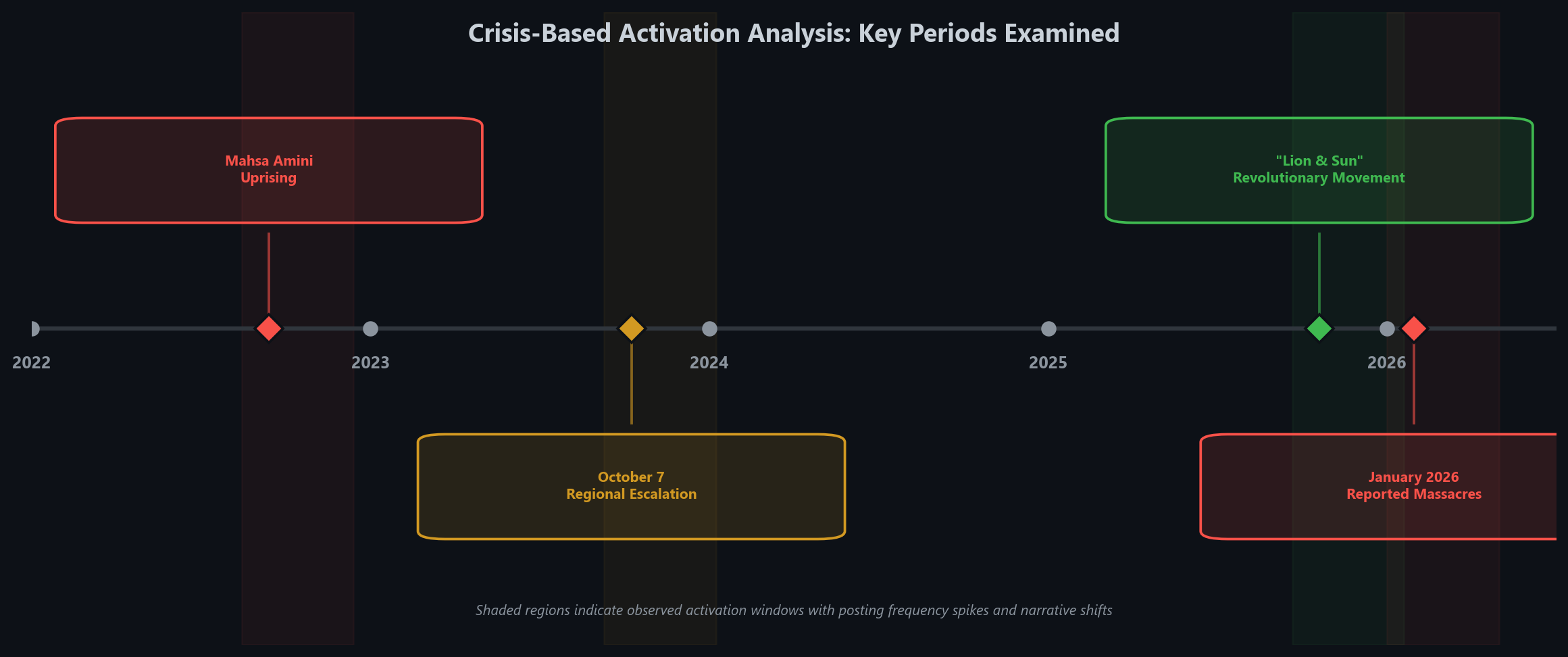
Content sampling was conducted across:
- The Mahsa Amini uprising
- The October 7, 2023 regional escalation
- The Lion & Sun revolutionary movement
- Randomized baseline periods between crisis events
For each period, researchers examined:
- Posting frequency changes
- Narrative shifts
- Amplification spikes
- Actor activation timing
Additionally, tens of intelligence-gathering accounts were examined, particularly those exhibiting elevated interaction patterns immediately following crisis events.
Content was analyzed in Persian and English.
3.5 Analytical Procedure
The analysis followed a structured, repeatable process:
-
Role-based categorization
Accounts were assessed according to behavioral indicators and assigned to actor categories defined in the study (e.g., originator, amplifier, narrative reservist).
-
Temporal activation analysis
Posting frequency, engagement behavior, and thematic shifts were evaluated across pre-crisis, crisis, and post-crisis windows.
-
Thematic clustering
Content was grouped into recurring manipulation methods based on observable framing, narrative intent, and functional impact.
-
Cross-role comparison
The same themes were compared across different actor types to identify functional specialization and coordination without assuming centralized command.
-
Qualitative validation
Manual review by researchers was used to validate automated clustering and to detect subtle framing strategies not reliably captured by quantitative metrics.
3.6 Intelligence-Gathering Account Assessment
Additionally, researchers analyzed more than 40 accounts classified as intelligence-gathering. These accounts were identified based on the following behavioral indicators:
- High engagement with opposition or activist users
- Low or absent participation in overt narrative promotion
- Post-crisis spikes in interaction frequency
- Behavioral patterns consistent with information elicitation rather than persuasion
These accounts were analyzed separately to avoid conflating influence activity with intelligence collection functions and to preserve analytical distinction between narrative-shaping actors and information-gathering roles.
3.7 Limitations
This research relies exclusively on open-source data and observable behavior. No claims are made regarding internal command structures, direct state tasking, or individual intent beyond what can be inferred from reproducible patterns.
The classifications used reflect analytical roles, not legal determinations or definitive attribution.
3.8 Methodological Rationale
By combining large-scale behavioral analysis with deep content review across multiple crisis contexts, this methodology enables identification of systemic narrative manipulation techniques while minimizing reliance on isolated examples or speculative attribution.
This approach prioritizes pattern consistency, temporal correlation, and functional role analysis, which are more robust indicators of influence operations than content polarity or volume alone.
4. Findings
4.1 Actor Architecture: A Diversified Virtual Influence Army
Modern influence operations rarely rely on uniform actors. Instead, they deploy heterogeneous role-based ecosystems, where each actor category performs a specific psychological or structural function within the information environment. This diversification increases resilience, deniability, and reach across demographic and ideological boundaries.
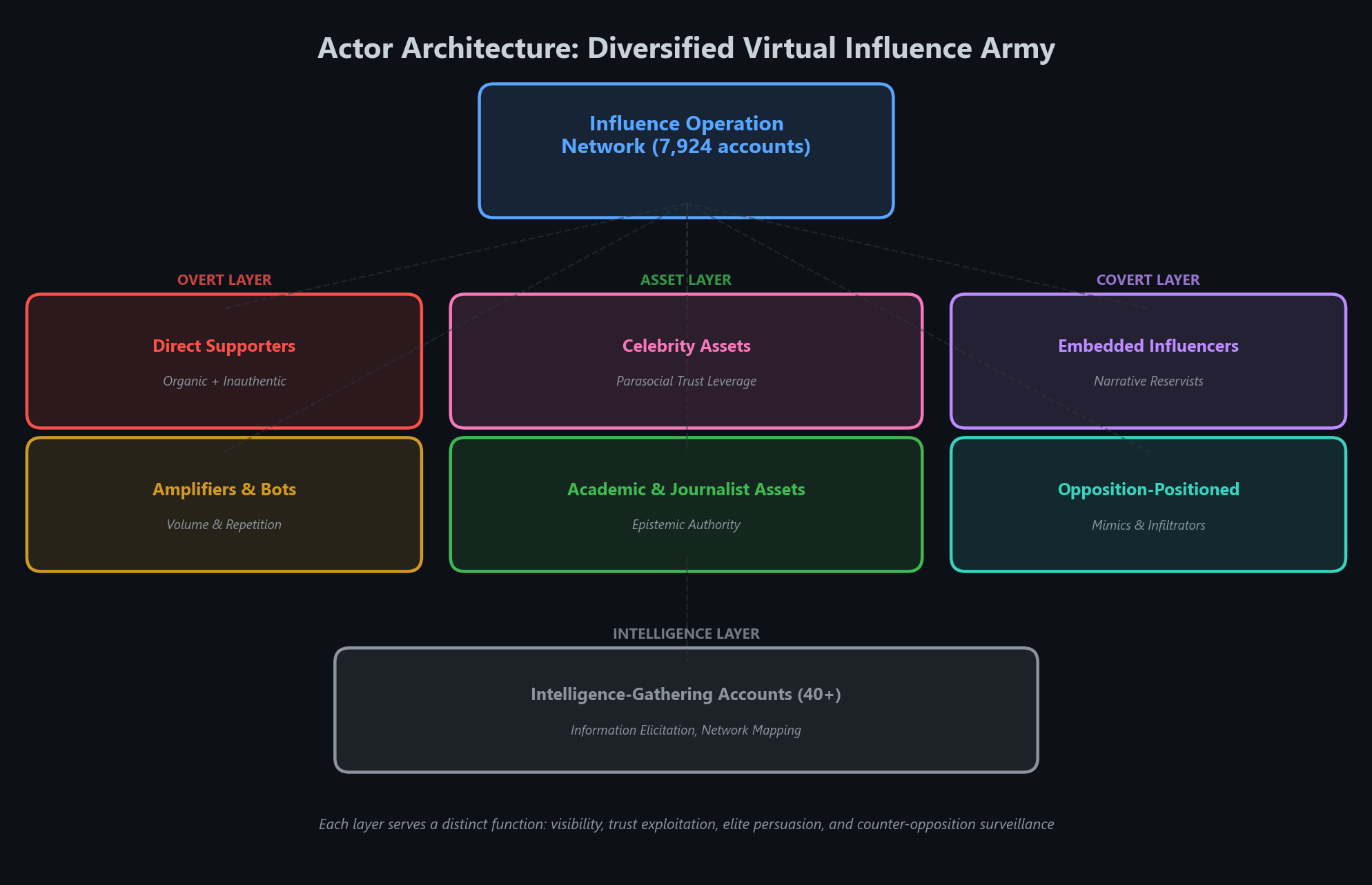
4.1.1 Direct Supporters
Accounts that openly support regime leadership, policies, and ideological narratives.
This category divides into two empirically distinct subtypes:
- Organic ideological supporters
Real individuals expressing genuine belief, identity alignment, or perceived personal interest. These accounts show consistent ideological framing over time and largely organic engagement patterns.
- Inauthentic or semi-automated supporters
Accounts exhibiting amplification behavior, posting frequency anomalies, or coordination indicators. Their function is volume, repetition, and visibility rather than persuasion.
Operational role: Establish baseline narrative presence and normalize regime-aligned discourse.
4.1.2 Embedded Influencer Accounts (Narrative Reservists)
Embedded influencer accounts function differently from conventional propaganda actors. Their primary value lies in trust accumulation during non-political periods, enabling later intervention without triggering suspicion.
Accounts that do not normally engage in political discourse and instead build audiences through:
- casual lifestyle content
- viral or meme-based posts
- erotic, provocative, or contradictory material
- entertainment-oriented engagement
Key characteristics:
- No consistent political alignment during baseline periods
- Normal follower/following ratios
- No overt coordination signals
- High trust and relatability within specific demographic niches
During crises, these accounts activate selectively, presenting regime-aligned framing as personal opinion, emotional reaction, or “reasonable moderation.”
Operational role: Narrative normalization and demographic-specific persuasion at critical moments.
4.1.3 Opposition-Positioned Agents
Opposition-positioned agents exploit identity proximity rather than ideological distance. By appearing aligned with protest movements, they gain access to trust networks otherwise inaccessible to overt regime supporters.
Accounts that present themselves as opposition voices but act to redirect, fragment, or neutralize mobilization during high-risk periods.
Observed subtypes:
- Direct opposition mimics
Accounts openly engaging in opposition discourse while subtly introducing defeatism, misdirection, or internal conflict narratives.
- Infiltrated mobilization nodes
Accounts that embed within protest or activist communities, gain trust, and intervene during escalation phases to dilute momentum or reframe objectives.
Operational role: Opposition containment through internal disruption rather than external attack.
4.1.4 Celebrity Asset Operations
Celebrity influence leverages parasocial trust, where audiences perceive familiarity and authenticity independent of political expertise.
Public figures with large followings activated selectively during crises.
Observed mechanisms include:
- coercion following arrest or legal pressure
- conditional privileges in exchange for cooperation
- artificial amplification to elevate compliant figures
Content typically avoids explicit regime endorsement, instead promoting:
- ambiguity
- “both-sides” framing
- calls for de-escalation beneficial to regime survival
Operational role: High-credibility narrative intervention with minimal overt alignment.
4.1.5 Academic and Journalist Asset Operations
Academic and journalistic assets function through epistemic authority, shaping what is perceived as reasonable, complex, or credible.
Use of academics, analysts, and media figures to legitimize preferred narratives through argumentation rather than propaganda.
Common patterns:
- hypothesis framing aligned with regime interests
- selective skepticism toward opposition claims
- moral equivalence framing
- “complexity” arguments that delay or dilute action
Notably, some accounts appear critical of the regime while still advancing narratives that ultimately serve regime objectives.
Operational role: Elite discourse shaping and policy-adjacent influence.
4.1.6 Intelligence-Gathering Accounts
Influence operations frequently combine persuasion with counter-opposition intelligence collection.
Accounts that do not participate in narrative shaping but focus on information collection.
Behavioral indicators include:
- casual engagement designed to elicit replies
- social engineering through empathy or shared identity
- follower mapping of opposition networks
Operational role: Identification of real individuals behind anonymized opposition accounts, enabling harassment, intimidation, or offline targeting.
4.2. Content Manipulation Methods
Content manipulation methods are designed to operate across emotional, cognitive, and temporal dimensions. Rather than persuading audiences directly, these techniques aim to reshape the environment in which interpretation occurs.
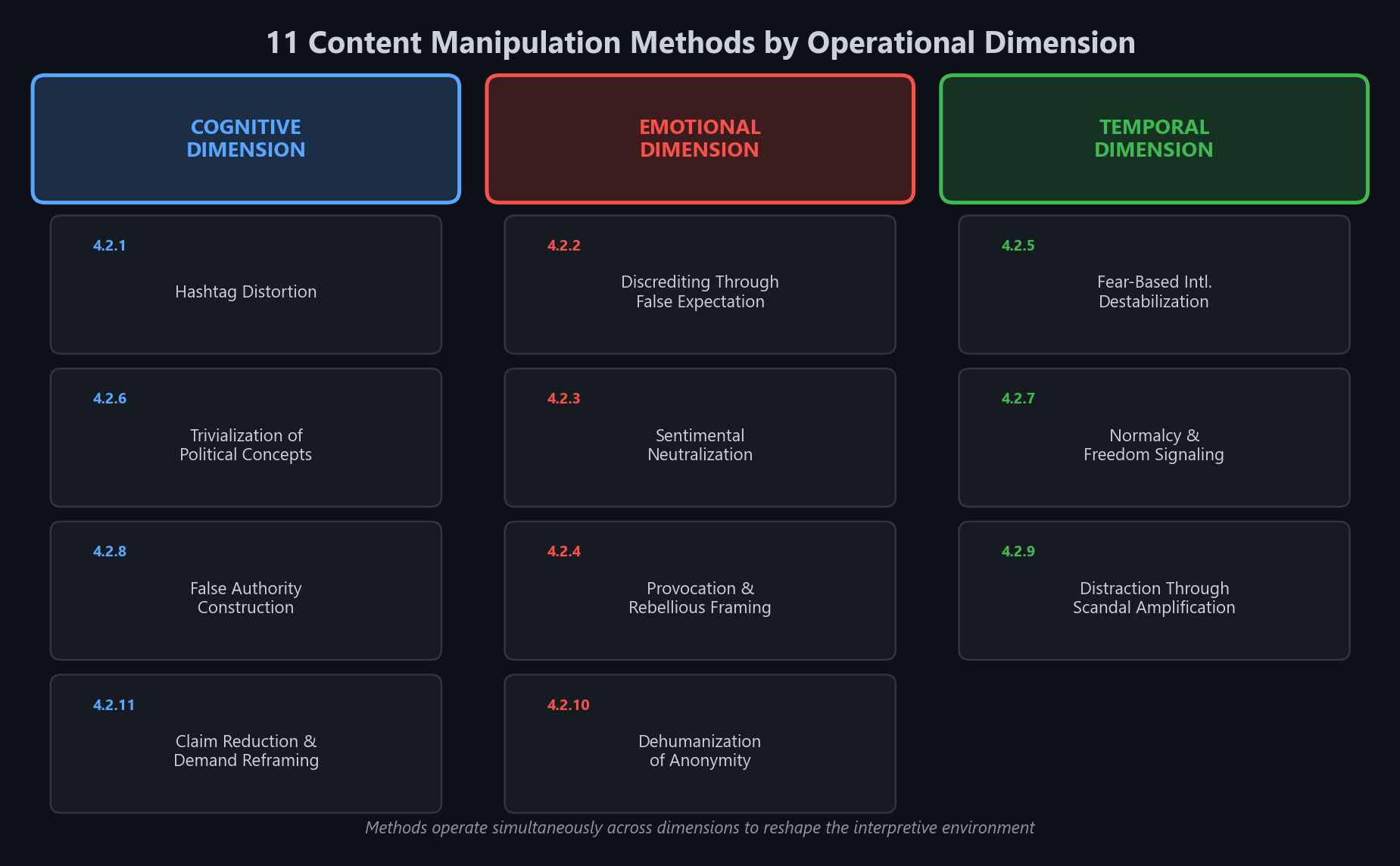
The qualitative expansion phase demonstrated consistent alignment between observed content manipulation methods and the four primary narrative objectives identified in the initial quantitative research: anti-Pahlavi campaigns, anti-Semitic framing, regime glorification and reformability narratives, and the elevation of MEK and separatist alternatives.
4.2.1 Hashtag Distortion
Deliberate creation of near-identical hashtags differing by one or two characters to fragment discourse and weaken visibility of genuine movements.
Observed most frequently during periods of mass mobilization.
4.2.2 Discrediting Through False Expectation
Use of exaggerated casualty figures, premature victory claims, or imminent collapse narratives to generate false hope, followed by disillusionment and disengagement.
4.2.3 Sentimental Neutralization
Promotion of emotionally resonant but politically inert actions during moments requiring collective mobilization (e.g., symbolic art, poetry, passive reflection).
Effect: Emotional discharge without strategic pressure.
4.2.4 Provocation and Rebelious Framing
Encouragement or amplification of vandalism and aggressive acts, followed by portrayal of the opposition as violent or illegitimate.
4.2.5 Fear-Based International Destabilization Framing
Promotion and amplification of narratives portraying Iran as on the verge of fragmentation and regional chaos, with the explicit or implicit aim of influencing Western risk perception.
Observed tactics include:
- Exaggeration of ethnic and separatist movements to suggest imminent territorial breakdown
- Artificial visibility and overrepresentation of MEK-aligned narratives to imply loss of centralized control
- Framing regime survival as the “lesser evil” compared to instability affecting neighboring states and the European Union
Effect: Shifts external stakeholder focus from legitimacy and human rights toward containment, stability, and risk aversion.
4.2.6 Trivialization of Political Concepts
Systematic misuse of terms such as “democracy,” “freedom,” “unity,” and “solidarity,” redefining them situationally to align with regime interests.
Simultaneously, labels such as “dictatorship,” “censorship,” or “aggression” are applied to opposition actors.
4.2.7 Normalcy and Freedom Signaling
Systematic dissemination of content portraying daily life in Iran as normal, stable, and unconstrained, particularly during periods of widespread unrest.
Common themes include:
- Emphasis on leisure activities, consumption, and cultural events
- Selective portrayal of women’s visibility and autonomy as evidence of freedom
- Minimization of protest scale by presenting dissent as isolated or episodic
Effect: Narrative dilution aimed at reducing perceived urgency, legitimacy, and mass character of revolutionary movements.
4.2.8 False Authority Construction
Artificial elevation of selected opposition figures through likes, reposts, and follower inflation to present them as leaders or consensus voices.
4.2.9 Distraction Through Scandal Amplification
During crisis periods, coordinated amplification of sensational, scandalous, or emotionally charged but politically unrelated content.
This content typically:
- Triggers outrage or moral polarization
- Dominates trending topics and timelines
- Diverts attention from protest documentation and opposition messaging
Effect: Temporal displacement of attention away from regime-critical narratives at decisive moments.
4.2.10 Dehumanization of Anonymity
Delegitimization of anonymous opposition accounts by framing anonymity as proof of dishonesty, foreign manipulation, or cowardice, despite anonymity being a rational safety measure under repression.
4.2.11 Claim Reduction and Demand Reframing
Deliberate narrowing of opposition demands to non-existential grievances in order to neutralize revolutionary legitimacy.
Observed reframing includes:
- Reducing systemic regime-change demands to “economic dissatisfaction”
- Framing mass protests as limited to specific social policies (e.g., hijab enforcement)
- Presenting opposition goals as reformist rather than transformational
Effect: International misinterpretation of movement objectives, leading to inadequate political, media, and policy responses.
5. Analytical Conclusion: Consequences of Narrative Manipulation
Narrative manipulation does not merely distort perception; it reshapes decision-making environments. When sustained at scale, it alters how legitimacy, urgency, and risk are evaluated by the public, media institutions, digital platforms, and policymakers.
Unlike isolated misinformation events, structured narrative manipulation operates cumulatively. It influences which voices gain visibility, which frames dominate discussion, and which interpretations appear reasonable or extreme. Over time, this reconfiguration of interpretive space affects not only public discourse but also institutional responses.
The consequences observed include:
-
Delayed international response to violence and repression
By reframing unrest as localized, exaggerated, externally driven, or economically limited, narrative manipulation reduces perceived urgency and weakens coordinated diplomatic or policy action.
-
Fragmentation of opposition movements
Through amplification of internal disagreements, elevation of alternative “acceptable” opposition figures, and tactical promotion of divisive narratives, collective cohesion is weakened at critical moments.
-
Normalization of authoritarian narratives in democratic discourse
When regime-aligned frames are repeatedly presented through diverse and seemingly independent actors, they enter mainstream debate as legitimate viewpoints rather than strategic messaging.
-
Erosion of trust in authentic grassroots voices
Dehumanization of anonymous activists, strategic exaggeration of claims, and artificial authority construction generate skepticism toward genuine civic actors.
-
Distortion of risk perception in Western policy environments
Fear-based framing of instability, fragmentation, or regional chaos shifts external decision-making from legitimacy-based considerations toward stability-first calculations.
-
Attention displacement during crisis escalation
Coordinated distraction campaigns and scandal amplification temporarily redirect public focus, reducing visibility of events unfolding on the ground at decisive moments.
Reduced Visibility During Reported Massacres
One of the most consequential impacts identified in this research concerns the reduction of international visibility during January 2026, a period in which multiple independent media outlets described events as massacres and reported that tens of thousands of individuals were killed, injured, detained, or subjected to severe state violence. While precise figures remain difficult to independently verify due to communication restrictions, the scale and severity of violence were widely documented.
During these period, authorities imposed large-scale internet shutdowns and communication restrictions, significantly limiting the ability of ordinary citizens to document events. At the same time, coordinated narrative activity intensified across external information environments.
The observed narrative patterns included:
- Introduction of doubt regarding casualty figures
- Framing reports as exaggerated or unreliable
- Shifting discourse toward reform narratives or negotiation framing
- Elevating alternative crisis interpretations to dilute attention
These patterns were consistently aligned with messaging that appeared aimed at reducing the perceived popularity of the opposition-supported "Lion & Sun Revolution” and limiting the visibility of voices from people in Iran within international discourse.
In this context, social manipulation functioned not merely as an informational tactic but as a political instrument. By shaping external perception during communication blackouts and diplomatic signaling phases, narrative manipulation appears to have contributed to diminished international visibility and reduced policy urgency at critical moments.
This dynamic does not require proof of centralized command over every account involved. Rather, it demonstrates how coordinated framing and amplification, operating across borders, can materially influence how severe events are interpreted abroad when independent verification is constrained.
Continuity with Prior Quantitative Findings
The expanded qualitative analysis conducted in Phase 2 confirmed the core content objectives identified in the initial large-scale quantitative research. Across crisis periods and actor categories, the same strategic narrative themes persisted consistently.
Qualitative analysis of the results of the Phase 1 with detailed investigation of more than 10,000 posts, including from over 200 high-impact accounts reaffirmed the presence of the following primary content objectives:
-
Anti-Pahlavi campaigns
Sustained delegitimization efforts targeting the Pahlavi legacy and constitutional monarchy advocates, including reputational attacks, association tactics, and narrative framing aimed at reducing perceived viability.
-
Anti-Semitic framing
Recurring hostility toward Jewish identity, Israel, or related constructs, ranging from coded rhetoric to overt dehumanization.
-
Regime glorification and reformability narratives
Content portraying the Islamic Republic as either morally legitimate, strategically justified, internally reformable, or comparatively preferable to perceived alternatives.
-
Elevation of MEK and separatist alternatives
Disproportionate amplification of MEK-aligned messaging and ethnic or regional fragmentation narratives, positioning these as dominant or viable alternatives within opposition discourse.
The persistence of these themes across both quantitatively identified network actors and manually reviewed contents, including added ones from high-impact accounts indicates structural continuity rather than episodic messaging. While actor roles and delivery mechanisms adapted across crisis contexts, narrative objectives remained stable.
Crucially, the most effective mechanisms identified in this research are not overt propaganda tools but latent, trust-embedded actors and framing strategies that activate selectively during moments of maximum impact. These actors often operate within normal social, cultural, or professional environments, making detection more complex than identifying automated amplification alone.
The architecture documented in this study demonstrates that influence activity extends beyond content production. It involves:
- role differentiation (originators, amplifiers, reservists, infiltrators)
- temporal synchronization during crisis events
- cross-audience messaging tailored to Western information environments
- integration of persuasion and intelligence-gathering functions
As a result, countermeasures focused solely on bot detection or content removal are insufficient. Effective response requires attention to:
- actor architecture, not only message volume
- activation timing, not only message content
- framing dynamics, not only factual accuracy
- cross-border linkage patterns, not only domestic engagement metrics
Understanding these structural elements is a prerequisite for building resilient information ecosystems. Platforms, policymakers, researchers, and civil society actors must evaluate influence operations as adaptive systems rather than isolated incidents.
Narrative environments shape policy environments. When manipulation persists unaddressed, strategic perception gaps may emerge between events on the ground and their interpretation abroad. The long-term consequence is not only informational distortion but altered geopolitical decision-making grounded in reframed reality.
Contact: E-mail · Contact Form · X